
Here's the Gist
I wrote this guide to break down the key differences between recumbent and upright bikes so you can pick the right one for your home cardio. Both machines operate similarly with flywheels and resistance systems, but your choice ultimately comes down to prioritizing comfort or performance.
- Upright bikes place pedals beneath you, forcing good posture and engaging your quads, hamstrings, calves, glutes, core, and upper body.
- Recumbent bikes feature a low, wide seat with a backrest and forward pedals, offering lumbar support that reduces back and neck stress.
- Recumbent cycling disengages your core and provides lower impact on joints, making it ideal for seniors, back pain sufferers, or rehabilitation.
- Upright models suit performance goals and HIIT workouts, while narrower seats optimize cycling mechanics and minimize chafing during longer rides.
- Both styles offer foldable models and track metrics like heart rate, but recumbents take up significantly more space even when folded.
Are you looking to add more cardio to your exercise routine? If the answer is yes an at-home bike could be your perfect solution. The next step is finding the bike that’s right for you. Recumbent bikes and upright bikes are two of the most popular at-home bikes. We’re going to talk you through their differences and help you find the bike of your dreams.
Upright Bike
What Is It?
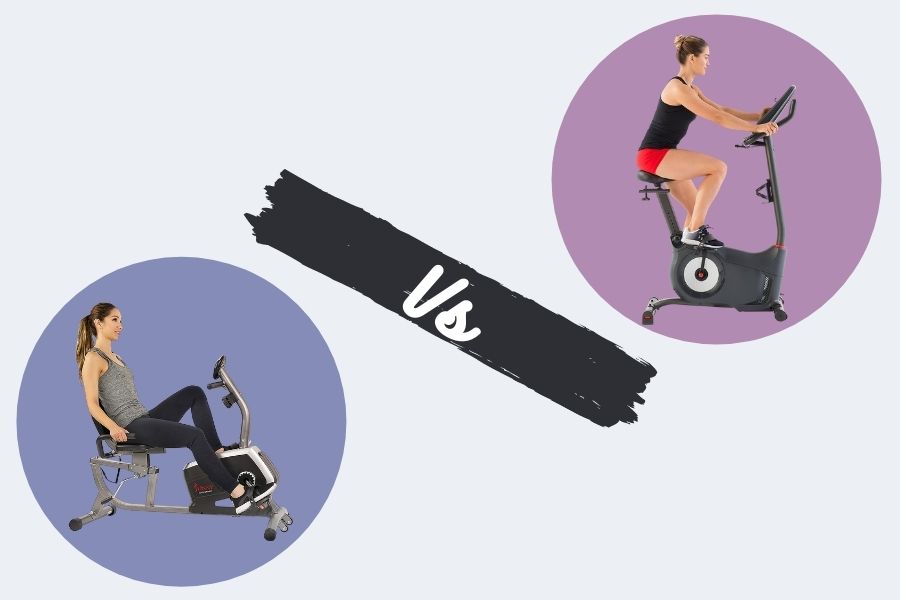
Upright bikes have been a popular choice by fitness fanatics and everyday athletes for years. Over these years, they’ve evolved into high-quality machines. Their style is simple yet effective. Your body is placed in an upright position and the pedals are located directly beneath your feet. Being in an upright position forces you to maintain good posture when cycling.
A lot of upright bikes have some really cool features. Many are foldable which is great if you don’t have a lot of spare room. Just take it out when exercising and store it in a cupboard or corner when it’s not in use. Some upright bikes even have attachable desks. If you have a desk job this is a great way to add extra movement into your day. Pedaling while you work also means you won’t have to worry about fitting exercising around your work.
Most upright bikes operate by a light flywheel. They’re manufactured using a crankshaft and bottom bracket which turns the flywheel via a chain or belt. Resistance is generated using fan, magnetic, or electromagnetic resistance. A lot of upright bikes will show you your heart rate, distance, speed, and calories burned while you cycle. Real-time data is an incredible tool to help you track your progress and workouts. Additionally, many upright bikes will have preset programs you can follow during your workout. Preset programs are a great way to add structure and variety to your training.
Upright Cycles: Pros & Cons
Recumbent Bike
What Is It?
The first thing you’ll notice on a recumbent bike is its unique seat positioning. The recumbent bike has a backrest and a low seat. This angle makes it feel like you’re relaxing back in a chair. The pedals are in front of you so your cycling position is altered. Many people like the laid-back style of recumbent bikes as it allows them to watch television or read whilst exercising. If you’re pressed for time and are choosing between exercise and relaxing, recumbent bikes are the perfect solution. Another benefit of the laid-back position is its lumbar support. If you suffer from lower back pain, lumbar support can help relieve it. Recumbent bikes also have a wide seat to add extra comfort and support.
Similar to upright bikes, recumbent bikes also work using a light flywheel. The flywheel is connected to the pedals via a chain or belt and resistance is created using fan, magnetic, or electromagnetic resistance. Most recumbent bikes will display heart rate, distance, speed, and calories burned during your cycle. Many will also have preset programs you can use as part of your training. More and more recumbent bikes are also attaching resistance bands to their frame. This allows you to work your upper body muscles while you cycle. If you’re looking for a simple and effective way to train your entire body, this is the perfect solution. Just like upright bikes, some recumbent bikes are foldable.
Recumbent Cycles: Pros & Cons
Differencies
Body Position
One of the biggest differences between an upright bike and a recumbent bike is the body position. On a recumbent bike, your body sits within the frame. The seat is low and the pedals are in front of you. This creates an almost horizontal position for your legs. The added backrest allows you to lean your torso back into a comfortable position. On an upright bike, your body sits above the frame. Similar to how you would sit on a traditional bike. The pedals are below you to put your body in an almost vertical position. The laid-back position of a recumbent bike can reduce stress on your back and help prevent stiffness in the back and neck. But, an upright position is more suitable for performance. Which bike you choose will depend on what’s more important to you; comfort or performance.
Seat
The seats on recumbent bikes are much wider than the seats on an upright bike. Some people find the narrow seat on an upright bike uncomfortable. But, narrower seats put your legs in a better position for cycling and can help reduce chafing during longer rides. If you’re looking to perform on a bike, an upright bike would be more suitable. However, if you’re looking for maximal comfort during shorter rides, a recumbent bike is the better choice.
Pedal Position
Pedal positioning affects which muscles you’re working during cycling. On a recumbent bike, the pedals are in front of you. This means your pedaling in an almost horizontal position. However, on an upright bike, the pedals are below you. Thus, you’re pedalling in more of a vertical position. Pedaling in a vertical position works your quads, hamstrings, calves, glutes, and core. But, when you’re laid-back on a recumbent bike your core becomes disengaged. Although, a major benefit of the pedal position on a recumbent bike is it is lower impact. Less stress on your joints is ideal for older populations and those with injuries or neurological conditions. Again, it’s a choice of performance vs comfort.
Space
Recumbent bikes and upright bikes are available in foldable options. If you don’t have much room to spare you can simply fold it up and store it away. But, recumbent bikes are much bigger than upright bikes even when folded. If you’re very limited with space make sure you measure out the dimensions before making a purchase.
Related
Recumbent vs Indoor Cycles
Upright vs Indoor Cycles
Recumbent Bike vs Upright: Which Muscles Do You Work?
We mentioned pedal positioning influences muscle engagement. Recumbent bikes work the quads, hamstrings, calves, and glutes. But, due to their laid-back nature, they fail to engage the core. On an upright bike, you engage more muscles. An upright bike works your quads, hamstrings, calves, glutes, core, and upper body. Holding onto the handles of an upright bike helps work your upper body too. It works it to a lesser extent compared to the lower body but still provides more stimulation than recumbent bikes.
Verdict: Which Is the Best for Me?
Recumbent bikes and upright bikes are very similar in the way they operate. But, they differ vastly in terms of body positioning.
Overall, recumbent bikes are more suitable for those who want maximal comfort. They’re best suited to older populations, people with back pain, or neurological conditions. Upright bikes are best for those who want to engage their full-body and work on their performance.
Quick Answers
Is a recumbent bike better for lower back pain than an upright bike?
Yes. Recumbent bikes feature a backrest that provides lumbar support to help relieve lower back pain. The laid-back position reduces stress on your back and helps prevent stiffness in your back and neck. Upright bikes place you in a vertical position, which prioritizes performance rather than back comfort.
What muscles do upright bikes work compared to recumbent bikes?
Upright bikes engage more muscles, working your quads, hamstrings, calves, glutes, core, and upper body via the handles. Recumbent bikes work your quads, hamstrings, calves, and glutes, but the laid-back position disengages your core. However, some recumbent models offer attachable resistance bands to train your upper body.
Which bike is better for performance and HIIT workouts?
Upright bikes are more suitable for performance and can be used for HIIT training. Their vertical cycling position forces good posture and engages your core and upper body. Recumbent bikes focus on comfort and low-impact exercise rather than performance, placing your body in a relaxed, horizontal pedaling position.
Which bike takes up less space: recumbent or upright?
Upright bikes take up less space. Although both upright and recumbent bikes come in foldable options that you can store in a cupboard or corner, recumbent bikes are much bigger than upright bikes even when folded. We recommend measuring your dimensions before making a purchase.
Who should choose a recumbent bike over an upright bike?
Recumbent bikes are best for anyone seeking maximal comfort or a low-impact workout that puts less stress on joints. They are particularly suitable for older people, those with injuries, lower back pain, or neurological conditions, and anyone wanting to relax, read, or watch television while cycling.
